A kitchen order is typed into the design software, then the quote, then the supplier order, then the accounts, then the fitting diary. In a services firm it is a new client: the CRM, the project tool, the accounts, the onboarding checklist. Each copy takes a few minutes. Nobody adds them up.
Because the time is spread across people and days, it never shows up as one line in the accounts. Here is a sum that takes two minutes and turns it into one number.
Signs it costs more than you think
- The same customer or order is typed into three or more tools.
- Someone spends part of every week checking that two systems match.
- A changed order means updating four or five places by hand.
- The answer to growth is "we need another admin".
- Mistakes from copying reach customers: a wrong size, price or address.
The sum
Yearly cost
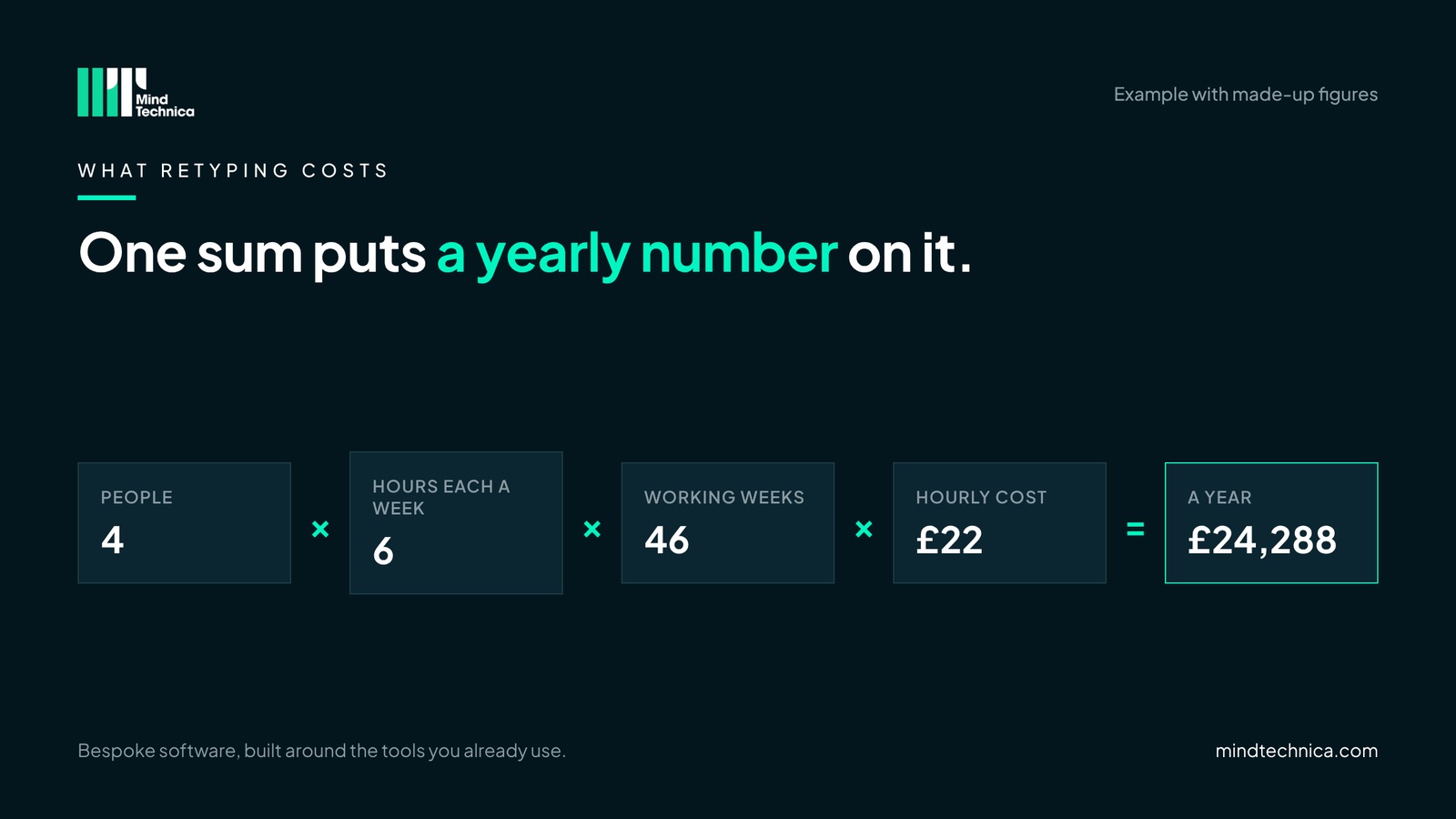
People who retype or cross-check details × hours each a week × 46 working weeks × hourly cost, including employer costs.
A worked example
| Step | Figure |
|---|---|
| People who retype or cross-check | 4 |
| Hours each, per week | × 6 |
| Working weeks a year | × 46 |
| Hourly cost, including employer costs | × £22 |
| Yearly cost | = £24,288 |
Example with made-up figures. Your own number is the one that matters.
That is roughly two-thirds of a full-time role, spent copying details that already exist somewhere else in the business. And it grows with every new customer, unlike most overheads.
Getting your numbers right
- Count cross-checking too. Comparing two systems to see whether they match is part of the same cost.
- Use the full hourly cost, including employer costs, not just the wage.
- Don't guess the hours. Ask each person to jot down every retype for three days: what, where and how long. Three days of notes beats any estimate.
- Use 46 weeks, not 52: holidays and bank holidays come off.
What it looks like in practice
In a kitchen, bathroom or bedroom showroom
Count the places one kitchen order is typed: design, quote, supplier order, accounts, fitting diary, sometimes a job sheet for the fitter. A revised quote after the customer moves the sink means most of those again. Multiply by the kitchens you sell in a year, not a week, and the number becomes real.
In a growing business with several tools
Count the places one new client is typed: CRM, project tool, accounts, onboarding checklist, mailing list. Then add the monthly job of checking the CRM against the accounts before the board pack. That reconciliation is part of the same cost, and it is often the part nobody mentions.
What the sum leaves out
The hours are the visible part. Each copy is a chance to copy wrong, and those mistakes often cost more than the minutes: a remake, a second visit, a customer who quietly goes elsewhere because the revised quote took three days. The sum is a floor, not a ceiling.
What to do with the number
Not all of this time can be removed. The part spent typing the same details a second time usually can, by letting the tools share them. Put your yearly figure next to what fixing the worst handover would cost once, and the decision usually becomes clearer.
Mistakes to avoid
- Counting only one person. Retyping is spread across the team; that is why it hides.
- Trying to remove it all at once. Fix the handover that takes the most minutes first.
- Using the number to blame anyone. The time goes into the gaps between tools, not into people working slowly.
Try this tomorrow
Ask everyone who retypes details to keep a three-day tally. On Friday, add it up and run the sum. Then pick the single handover that takes the most minutes.
Get the full version, free
The retyping check: 8 questions and 2 minutes. It runs the sum in your currency, scores where the time goes, gives a 30-day plan, and builds a page for your MD with the working shown. Inside, for example: a yearly cost, the two fixes to start with, and a week-by-week plan for your weakest area.
Ask us for the link through mindtechnica.com. Need to convince whoever signs off? Choose "build the case" at the start of the check (mindtechnica.com/retyping-check#case), and it turns your numbers into one page to forward. Prefer paper? Ask for What Typing It In Again Costs Us.
Questions people ask
Why 46 weeks and not 52?
Holidays, bank holidays and sick days come off. 46 is a fair working year for most UK and Irish businesses.
Our team says it only takes a few minutes. Is it worth counting?
A few minutes, several times a day, across several people, adds up quickly. The three-day tally usually surprises people, and it settles the question either way.
What hourly cost should we use?
The full cost of the people doing it, including employer costs such as national insurance and pension contributions, not only their hourly wage.
Related reading
- One customer, five versions: which tool is the master?
- Buy, connect or build? Three questions to ask first
- How to stop kitchen quotes going cold
Want a second pair of eyes? Book a free 20-minute call at mindtechnica.com. We'll look at where your team types the most, and if a ready-made tool or the software you already have can do the job, we'll tell you.
Bespoke software, built around the tools you already use.