A couple visit the showroom on Saturday, spend two hours with a designer and leave with a quote they love. On Monday the designer has three new appointments. By the time anyone thinks of the couple again, it is three weeks later and they have signed with the showroom down the road, which rang them on Wednesday.
The customer never said no. Nobody in the showroom did anything wrong. The follow-up simply lived in one designer's inbox, and the next customer came first.
Signs quotes are going cold
- Nobody can say, in a minute, how many quotes are open and what they are worth.
- Follow-ups depend on each designer remembering.
- Quotes over a month old sit with no reply and no decision.
- A revised quote after a change takes days, not hours.
- You find out a sale was lost only when you ring months later.
Why it happens
It is rarely about effort. Quotes are created in the design software, sent by email and tracked, if at all, in someone's head. There is no single list of what is open, so nobody can see which quotes are going quiet until it is too late. Revised quotes are slow for a similar reason: one change has to be typed into the price, the supplier order and the paperwork, each in a different place.
One list, one rule, one weekly review
1. Put every open quote in one list
Customer, value, date sent, designer, next follow-up date. A shared spreadsheet is fine to start. Nothing lives only in an inbox.
2. Agree one simple rule
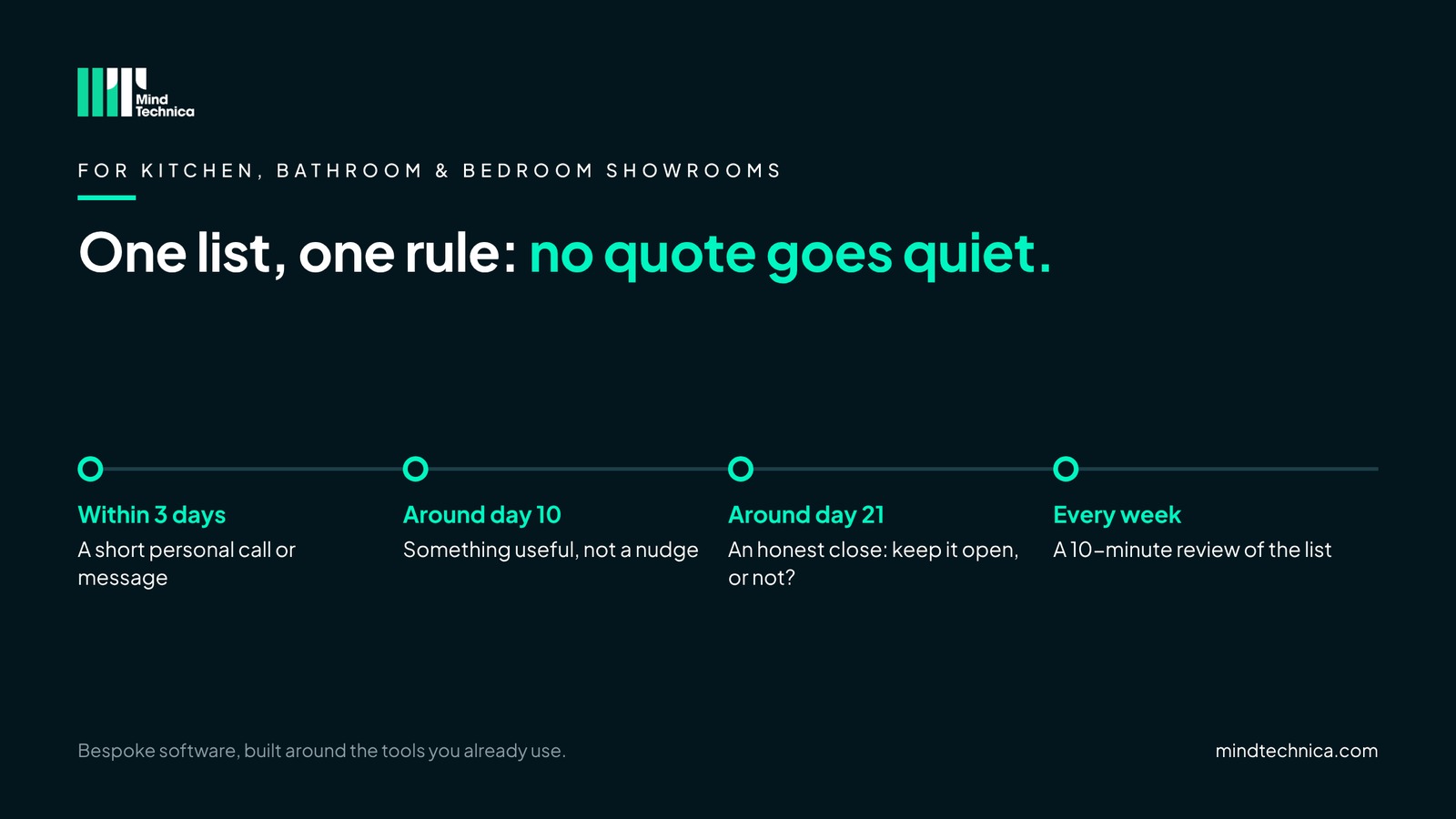
| When | What to send | In your own words, something like |
|---|---|---|
| Within 3 working days | A short personal call or message | "Did the drawings make sense? Anything you'd like to change?" |
| Around day 10 | Something useful, not a nudge | A photo of a similar finished kitchen, or the date the worktop price is held until |
| Around day 21 | An honest close | "Shall I keep this open, or have you gone another way? Either is fine." |
Adjust the days to your showroom. When the design changes, the clock restarts from the revised quote.
That last message gets more replies than you would expect. A clear "no" is worth more than a quote sitting open for months.
3. Hold a 10-minute review once a week
Same day, same time, everyone who quotes. Anything past its follow-up date gets an action or a new date. Mark every outcome as won, lost or no reply, and note why when you know.
4. Track two numbers
- The share of quotes followed up within 3 working days.
- The share of quotes that end with a clear answer, won or lost, rather than silence.
A count at the end of each month shows whether it is working. You don't need a dashboard.
What it looks like in practice
In a kitchen, bathroom or bedroom showroom
The quote is sent on a Saturday, after a long design session. The customer asks one question by email on Tuesday: can the island be 20 cm longer? The designer is on site at a fitting and sees it on Friday. By then the customer has visited another showroom that answered the same day.
In a growing business with several tools
The same pattern shows up anywhere quotes or proposals are sent: windows and doors, building services, agencies. The work that goes into the quote is careful and expensive; the follow-up is left to whoever has a spare moment. One list and one rule protect the time already invested.
A worked example
A showroom sends 40 quotes a month. Before the list, it guesses that "most" get followed up. The first month of counting shows 18 of 40 were chased within 3 days, and 15 ended in silence. A month later, with the list and the rule, 34 of 40 are chased on time, and silence drops to 6. Example with made-up figures; your first count is the one that matters.
Where software helps, later
Once the list exists, reminders can run on their own, and a first draft of each follow-up can be prepared from the quote for the designer to check and send. A person always sends it: customers buying a kitchen want to hear from their designer. And customer details stay in a business account, never a personal AI tool.
Mistakes to avoid
- Automating before the habit exists. Start with the list and the rule.
- Chasing with "just checking in". Send something useful instead.
- Leaving quotes open forever. The honest close is a kindness to both sides.
Try this tomorrow
List every quote over two weeks old with no reply. Give each one an owner and a follow-up date this week.
Get the full version, free
How to Stop Kitchen Quotes Going Cold: the four steps in full, the follow-up wording for each stage, and how AI drafting works once the list is in place. Inside, for example: the day-10 message ideas, the two numbers to track, and the two rules we keep when AI is involved.
Ask for it through mindtechnica.com and we'll send it the same day. No sales call attached.
Questions people ask
Is a spreadsheet good enough for the quote list?
To start, yes. What matters is one list everyone uses. Connecting it to the design software later saves typing each quote in.
Won't three follow-ups feel pushy?
Not if each one is useful and personal. The day-21 message gives the customer an easy way to say no, which many people appreciate.
What about revised quotes that take days?
Count how many places one change has to be typed into: price, supplier order, paperwork. That is usually where the days go, and where connecting tools helps most.
Related reading
- What does typing it in again cost? A simple sum
- Can't we just use ChatGPT? Why AI needs connected data first
- One customer, five versions: which tool is the master?
Want a second pair of eyes? Book a free 20-minute call at mindtechnica.com. We'll look at where your team types the most, and if a ready-made tool or the software you already have can do the job, we'll tell you.
Bespoke software, built around the tools you already use.