You have decided the tools you already pay for should work together. Now you are talking to suppliers, and every proposal sounds reasonable. The differences that matter, who owns the result, how it is rolled out, what happens if something goes wrong, are often in the small print or not written down at all.
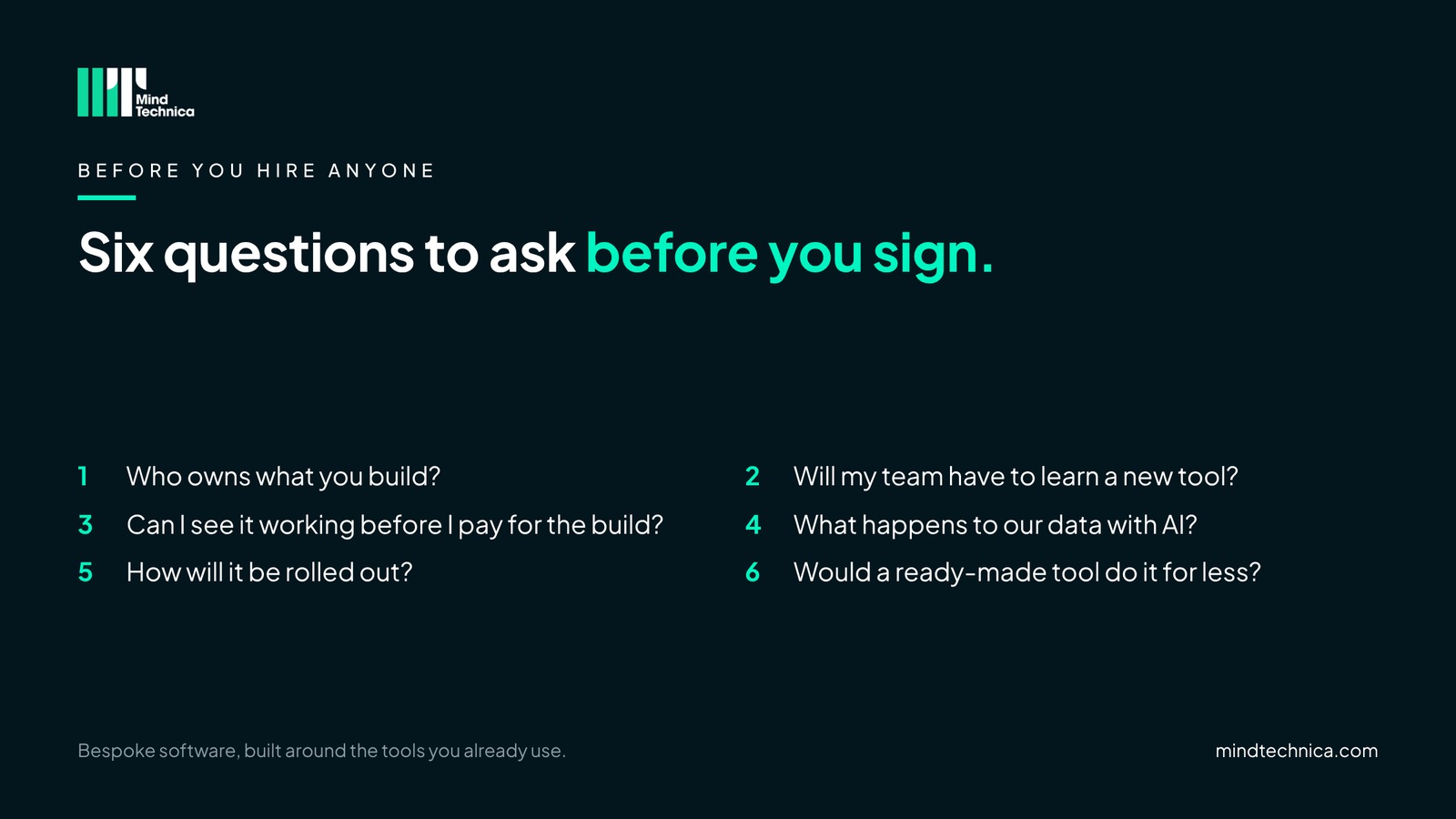
Whoever you work with, these six questions are worth asking before you sign. They are also the ones we are asked most, so we have included the answers we think you should expect.
Signs a proposal needs more questions
- It doesn't say who owns the code and where it runs.
- Everything goes live on one date.
- Your team hasn't seen or tested anything yet.
- Nobody has asked whether your current tools can already do it.
1. Who owns what you build?
You should own the code and the documentation, and it should run in an account in your name. Then, if the supplier disappeared, another developer could carry on. Ask to see what the handover includes.
2. Will my team have to learn a new tool?
Ideally not. People keep working in the tools they already use, and the connections do the copying. Where a new screen is needed, it should be sketched with the people who will use it, before it is built.
3. Can I see it working before I pay for the build?
A clickable prototype of your own process, tested by your team, takes the guesswork out. Ours is called a Blueprint: it has a fixed price, it ends with a fixed price for the build, and its fee comes off the build.
4. What happens to our data if AI is involved?
Business AI accounts, not personal ones. Connected AI should only see what each person is allowed to see, and your data should stay in your own accounts.
5. How will it be rolled out?
One workflow at a time. Each one goes live and settles before the next starts. A big switch on one date is where many software projects go wrong.
6. Would a ready-made tool do it for less?
A good supplier will tell you when the answer is yes, even if it means they don't get the work.
What it looks like in practice
In a kitchen, bathroom or bedroom showroom
A showroom group wants its design software connected to its accounts and fitting diary. One proposal replaces everything with a single new system; the other connects the tools the designers and the office already use. The second asks for less change from the team in the busy season, and the first workflow can be tested before anything else moves.
In a growing business with several tools
A growing business wants its CRM and project tool to share client details. One supplier proposes a custom platform; another connects the two tools and builds only the missing handover screen. The questions above make the difference between the two visible before anyone signs.
A worked example: comparing two proposals
| Question | Proposal A | Proposal B |
|---|---|---|
| Who owns the code? | Not stated | You, in your own account |
| New tool for the team? | Yes, everyone moves | No, existing tools connected |
| See it before the build? | No | Prototype tested by your team |
| Rollout | All at once | One workflow at a time |
| Price | Estimate | Fixed before you commit |
An example. The cheaper-looking proposal is often the riskier one.
Mistakes to avoid
- Comparing on price alone. Compare ownership, rollout and what you see before you pay.
- Leaving the team out until launch. They will find the gaps on day one.
- Signing for everything at once. Start with the workflow that hurts most.
Try this tomorrow
Write down the one worry that would stop you going ahead, and ask every supplier you speak to for a written answer to it.
Get the full version, free
The Questions We're Asked Before People Start: our straight answers to the nine questions that come up on many of our calls, written for whoever signs off the spend. Inside, for example: "What if you disappear?", "My team won't use another tool" and "Is it expensive?"
Ask for it through mindtechnica.com, or book the free 20-minute call and we'll send it afterwards.
Questions people ask
How much does connecting our tools cost?
It depends on the tools at each end and how many handovers are involved. A good supplier fixes the price before you commit, after seeing your process, and gives you a rough range on the first call.
How long does a project take?
It should be agreed in writing before the build starts. Rolling out one workflow at a time means the first one is working while the next is built.
What if we stop after the prototype?
Ask this before you start. It is a fair question, and the answer tells you a lot about the supplier.
Related reading
- Buy, connect or build? Three questions to ask first
- What does typing it in again cost? A simple sum
- Built your own CRM with AI? Six checks before it's critical
Book a free 20-minute call at mindtechnica.com. We'll answer these six for your project, in writing if you prefer.
Bespoke software, built around the tools you already use.