The deal is done. The new team keeps its own CRM for now, which is sensible: everyone is busy, and nobody wants to stop selling to move data. Some customers turn out to be in both systems, with different owners and different stages. That seems manageable.
It usually is, for a few weeks. The catch is that two systems holding some of the same customers drift further apart every month, and the problems tend to arrive in the same order, whether the group sells kitchens across several showrooms or services across several offices.
Signs it is already happening
- Leads are passed between the two teams by email.
- The board pack shows two pipeline numbers, or one that someone reconciled by hand.
- A shared customer has been contacted by both teams about the same thing.
- Nobody is sure which system holds the latest consent or unsubscribe.
- A full migration keeps being proposed and postponed.
A worked example: the first 100 days
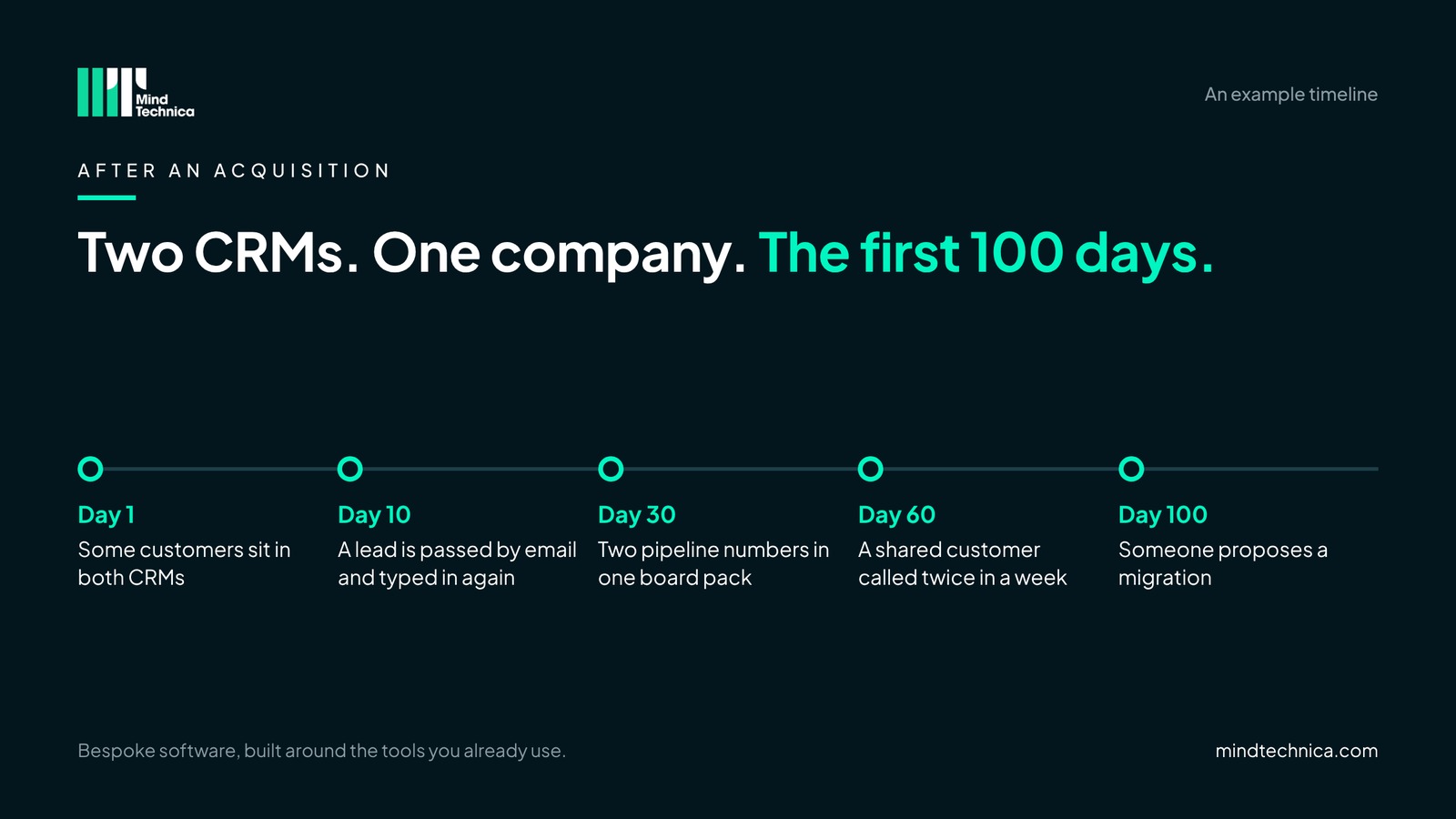
| When | What usually happens |
|---|---|
| Day 1 | Two CRMs. Some customers sit in both, with different owners and stages. |
| Day 10 | The first lead is passed from one team to the other by email, and typed in again. |
| Day 30 | The first board pack shows two pipeline numbers. The meeting starts with which one to believe. |
| Day 60 | A shared customer is called by both teams in the same week, and notices. |
| Day 100 | Someone proposes a full migration that nobody has time for. |
An example timeline. Your dates will differ; the order usually doesn't.
What it looks like in practice
In a kitchen, bathroom or bedroom showroom
A showroom group buys a second showroom. Both have their own CRM and their own way of tracking enquiries. Customers who visit both showrooms appear twice, and a designer in one showroom chases a customer who has already ordered from the other. The customer gets two calls and wonders whether the group talks to itself.
In a growing business with several tools
A services group acquires a smaller firm with overlapping clients. The acquired team keeps its CRM, and cross-selling begins by email. Leads are retyped, some are lost, and the first quarterly board pack has two pipeline numbers that nobody can reconcile in time for the meeting.
Why a migration in year one is risky
Moving everything into one CRM sounds tidy. In practice it lands in the busiest year the group will have, asks two teams to change how they work at the same time, and freezes decisions about which data is right until the move is done. Meanwhile the two systems keep drifting.
The middle way: one view, both CRMs stay
- One view shows each customer across both CRMs, with both histories.
- A change made once, such as a new phone number, reaches both.
- A lead passed between teams appears in the other team's pipeline without being typed in again.
- The board gets one pipeline number.
- Finance and accounts systems stay exactly as they are.
A migration can still happen later, from a clean starting point and at a time that suits you, or it may turn out not to be needed.
How to start in the first month
- Count the overlap. Export both customer lists and match them on company name or email domain.
- Agree who owns each shared customer, so only one team follows them up.
- Stop passing leads by email. Agree one way a lead moves between teams, even if it is manual at first.
- Pick one system for consent and unsubscribes, and make sure the other follows it.
- Decide which pipeline number goes to the board, and who reconciles it until the view is in place.
Mistakes to avoid
- Waiting for things to settle. They rarely do, and the data drifts further each month.
- Forcing one team onto the other's CRM straight away. It slows both teams in the year that matters most.
- Touching finance systems first. Start with customers and pipeline; accounts can follow later, if at all.
Try this tomorrow
Export the customer list from both CRMs and match them on company name or email domain. The number that appears in both is your starting point, and it is usually higher than people expect.
Get the full version, free
Two CRMs. One Company.: a short briefing for MDs, operations directors and investors: the example timeline, the middle way, and the questions to ask in your next board pack. Inside, for example: four board-pack questions, starting with "How many customers sit in both CRMs?"
Ask for it through mindtechnica.com and we'll send it the same day. No sales call attached.
Questions people ask
Should we migrate to one CRM eventually?
Sometimes. Once both teams work from one view, a migration becomes a calmer decision that can be made on its merits, and sometimes it turns out not to be needed.
Does this touch our accounts or ERP?
No. One customer view works on the customer and pipeline information in the CRMs. Finance systems stay as they are.
How do we stop both teams calling the same customer?
Agree an owner for every customer that sits in both systems, and make that owner visible in both. That alone removes most double calls.
Related reading
- One customer, five versions: which tool is the master?
- Why your reports don't agree (it isn't a reporting problem)
- Questions to ask before you pay anyone to connect your tools
Running two CRMs today? Book a free 20-minute call at mindtechnica.com. We'll walk through how one customer view across both would work for you, and what it would take.
Bespoke software, built around the tools you already use.