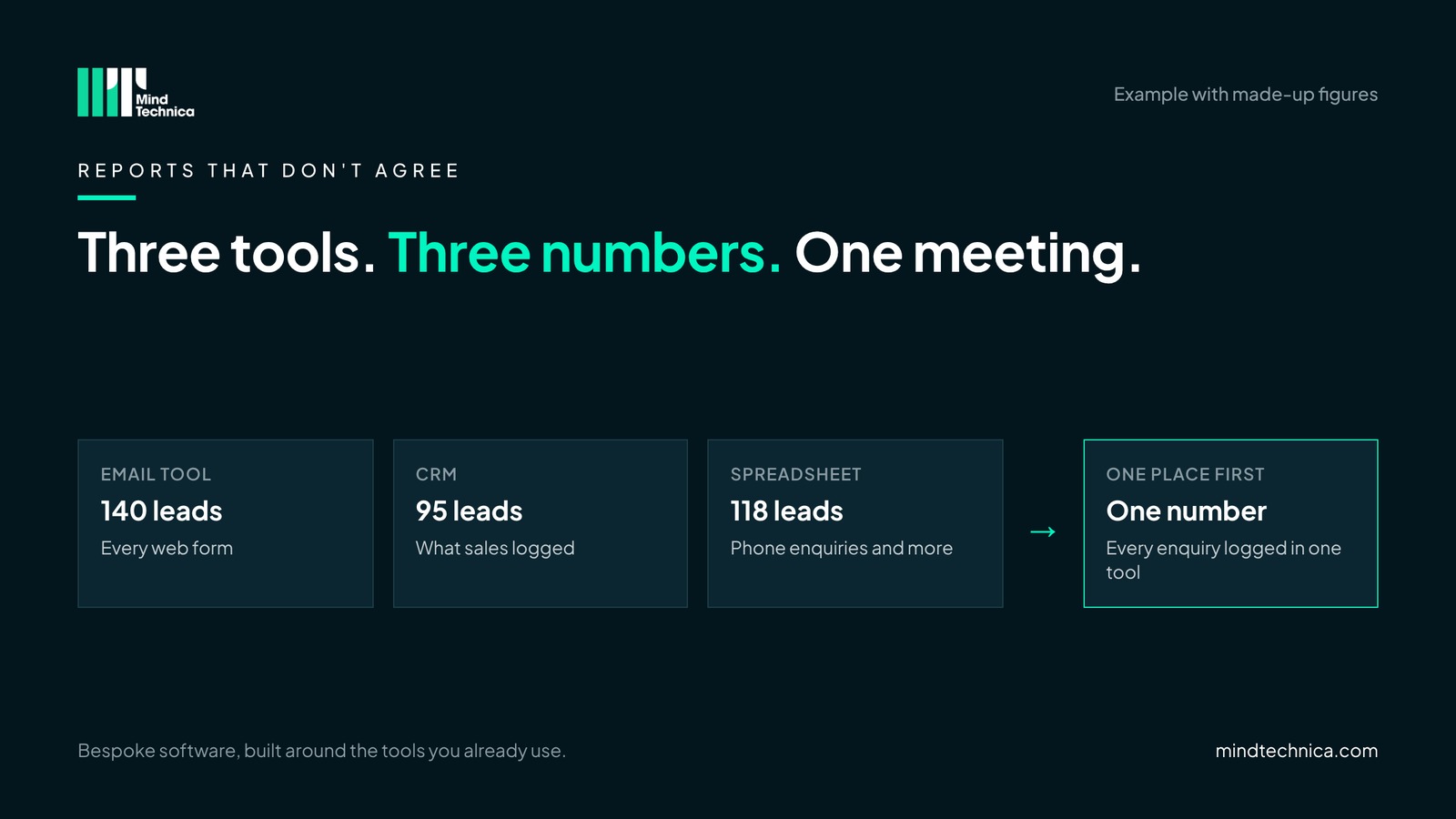
Monday's sales meeting. Marketing says 140 leads this month. Sales says 95. The office has its own figure in a spreadsheet. The first part of the meeting goes on which number to believe, and the decision that follows, a campaign cut or a hire made, is only as good as the number chosen.
It happens in showroom groups and services firms alike, and it is rarely anyone's fault. Each report is usually right about what it can see.
Signs you have this problem
- Meetings start with reconciling numbers rather than deciding.
- Someone spends time each month making reports match.
- Marketing and sales count leads differently.
- Customers are handed over by email between teams.
- Nobody is sure which report the board should see.
A worked example
| Where the enquiry arrives | Who counts it | This month |
|---|---|---|
| Web form, lands in the email tool | Marketing | 140 |
| Logged in the CRM by sales | Sales | 95 |
| Phone enquiries, office spreadsheet | The office | 118 |
Example with made-up figures. The same enquiry can appear in two places, spelt two ways; some never reach the CRM at all.
None of the three numbers is wrong. They are counting different things, in different places, with different rules about what a lead is.
What it looks like in practice
In a kitchen, bathroom or bedroom showroom
Enquiries arrive through the website form, phone calls to each showroom, and walk-ins. The marketing agency counts form submissions, the showrooms count appointments, and the owner counts quotes. Three numbers, all honest, none comparable. The question "is our advertising working?" can't be answered.
In a growing business with several tools
Leads arrive from the website, events, referrals and a partner portal. Marketing counts everything that comes in; sales counts what they qualified. Neither is wrong. Without one place where every enquiry is logged first, and one agreed definition, every meeting starts by reconciling.
It isn't really a reporting problem
A better report won't fix it, because the report can only show what each tool holds. The cause is where enquiries enter the business. Web forms land in one tool, phone calls in another, and sales log what they follow up. Until every enquiry is logged first in one place, every report gives a different answer.
Where the customer gets lost
The same thing happens at every handover. Sales passes a won customer to delivery by email, and delivery types it in again. Delivery hands over to support, and support starts from scratch. Each time, a detail can be lost or changed, and each team ends up with its own version of the truth.
How to get one number
- Pick one place where every enquiry is logged first, usually the CRM.
- Route web forms, emails and phone enquiries into it, rather than counting them separately.
- Write one definition of a lead and of a customer, and name the tool that counts each.
- At each handover, pass the record itself, not a copy, so the next team works from the same details.
- Report from that one place, and retire the side spreadsheets once the numbers match.
Mistakes to avoid
- Buying a reporting tool first. It will show three numbers more beautifully.
- Arguing about whose number is right. Agree the definition instead.
- Fixing the report but not the handover. The numbers drift apart again within weeks.
Try this tomorrow
At your next meeting, ask each team where its number comes from. Write the answers down. If there is more than one source, you have found the fix.
Get the full version, free
Map How One Job Moves Through Your Business: a free AI prompt that walks you through one job from first enquiry to invoice, one question at a time, and shows where details are typed in again. Inside, for example: up to eight questions, a simple map of every tool and handover, and the handover to fix first. Pair it with the free Tool Map Template, a Google Sheet that lists every tool and whether it can share data.
Ask for it through mindtechnica.com and we'll send it the same day. No sales call attached.
Questions people ask
Which tool should count leads?
Usually the CRM, because it is where sales work and where a lead becomes a customer. What matters most is that it is one place, agreed by everyone.
Do we need to connect the web forms to the CRM?
It is the most common fix. Many web form tools can send enquiries straight into a CRM, so nobody types them in.
How long before the numbers match?
Once every enquiry lands in one place, usually within a month: the first full month of reporting from one source.
Related reading
- One customer, five versions: which tool is the master?
- Two CRMs after an acquisition: the first 100 days
- Can't we just use ChatGPT? Why AI needs connected data first
Want a second pair of eyes? Book a free 20-minute call at mindtechnica.com. We'll look at where your team types the most, and if a ready-made tool or the software you already have can do the job, we'll tell you.
Bespoke software, built around the tools you already use.